
Imprecision detection
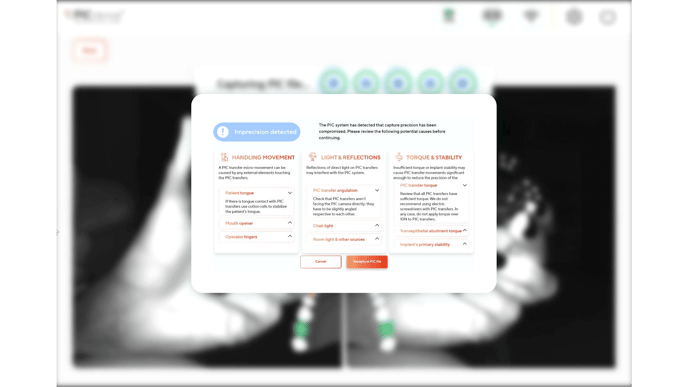
This is one category of potential reasons that can compromise the capture precision which is detected by the PIC system in the interactive detection screen.
There are other possible reasons that can affect precision:
By understanding these additional factors, you can effectively address and rectify any issues before attempting another capture.
MORE INFORMATION: Imprecision detected
Reflections of direct light on PIC transfers may interfere with the PIC system. There are three primary issues that arise in such cases.
PIC camera's infrared lights
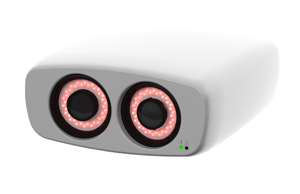
The PIC camera is equipped with light filters specifically designed to block light sources that could potentially impact optical scanners. It also features its own infrared illumination system, allowing for complete control over the illumination of the PIC transfers during the capture process. Therefore, the capture does not rely on or require ambient light to function effectively.
Strong and harsh light sources directed towards the patient's mouth can cause reflections on the PIC transfers. These reflections can have an adverse effect on the accuracy of measuring their positions during the capture.
To ensure precise measurements, it is recommended to avoid such light sources during capture and avoid their direct impact on the PIC transfers. By doing so, the system can capture the PIC transfers' positions accurately and reliably.
PIC transfer angulation
It is important to ensure that the PIC transfers are not directly facing the PIC camera but instead positioned at a slight angle relative to each other. If the PIC transfers are facing directly straight on to the camera, the PIC transfers will reflect the camera's lights and will not be readable. This guideline holds significant importance, whether you are dealing with a single pair of PIC transfers or multiple.
Ensuring the appropriate angulation between the transfers and the camera helps optimize the capture process, allowing for accurate and reliable data acquisition. By adhering to this practice, you can enhance the overall effectiveness and precision of the PIC system.
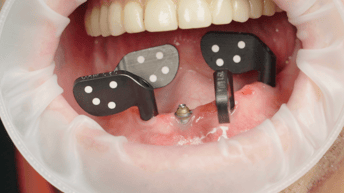
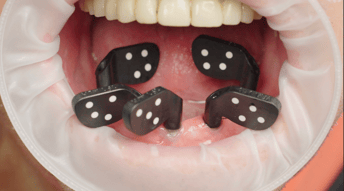 In the photo to the left, the PIC transfer located to the back left is displaying a light reflection because it is angled perfectly straight. This means that the PIC camera will be unable to pick up the data from that PIC transfer. In the photo to the right, the PIC transfer is angled back slightly, making it easier for the PIC camera to read the white dots.
Chair light 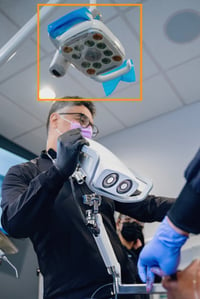
To ensure the accurate capture of PIC transfers, it is crucial to either turn off the overhead light of the dental chair or direct it away from the patient's mouth. This precautionary measure eliminates the possibility of any reflections interfering with the capture process.
By minimizing or avoiding reflections, the PIC system can obtain clear and undistorted data from the PIC transfers, enhancing the overall quality and reliability of the capture.
Room lights and other sources
It is important to be mindful of strong ambient light sources, including headlamps, sunlight, camera flashes, and intense room light fixtures, as they can interfere with the capture process and cause reflections on the PIC transfers.
To ensure optimal results, it is crucial to minimize or eliminate these light sources during the capture procedure. For instance, if the doctor is wearing a headlamp, it is vital to turn it off to prevent any potential interference. By taking these precautions, the capture of PIC transfers can be performed with minimal disruptions.
Optimal patient position to avoid reflections
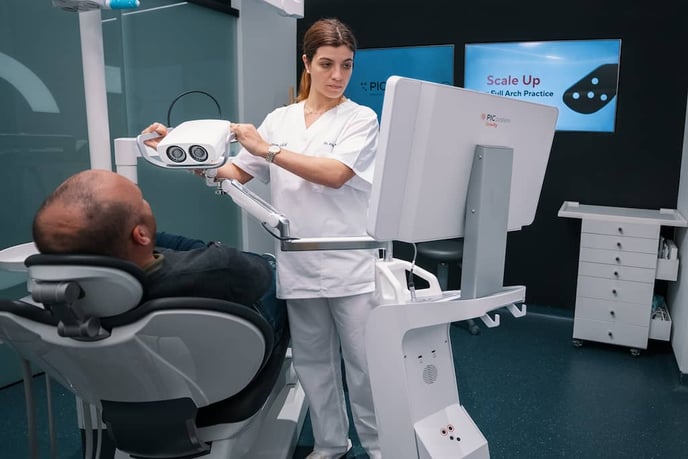
To reduce potential reflections coming from light sources located above the patient, it is recommended to position the patient upright with their head facing forwards.